The five seats
| Office | Skill | Responsibility |
|---|---|---|
| Shtadlan | Diplomacy | Representation before the host and goodwill outside the community |
| Gabbai | Stewardship | Revenue, building, fairs, and tzedakah |
| Rosh ha-Shmirah | Martial | The Quarter’s defence, travellers, and revenue farming |
| Ne’eman | Intrigue | Trust, secrets, and the pledge chest |
| Dayyan | Learning | Law, teaching, study, and the Bet Din |
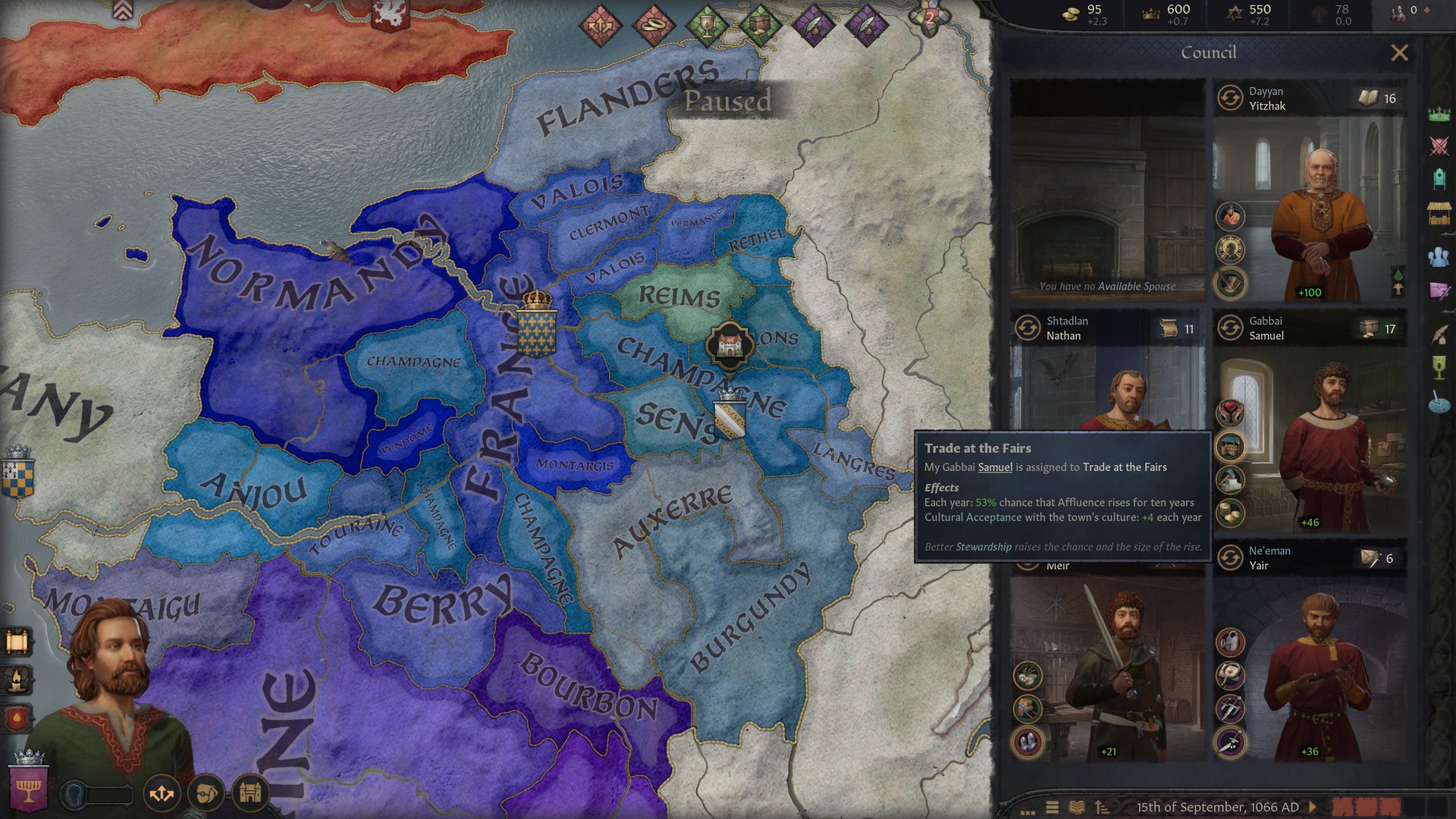
Since 0.2.0, each office has three or four tasks, each with its own icon. A task’s tooltip gives its chance and effect for the officer you appointed.
The host and the neighbourhood
Petition the Host concerns the ruler’s opinion, settlement policy, outlook, and charter. Cultivate Goodwill, formerly Seek Protection, concerns people around the community: Stability, religious restraint, and relations across faiths. These tasks answer different sources of insecurity.
Money, trade, and charity
The Gabbai can raise communal revenue, oversee construction, trade at fairs, or manage tzedakah. The fairs support economic relations and cultural acceptance; tzedakah connects local religious life with mutual aid. Construction work can also help after violence.
The Rosh ha-Shmirah can defend the Quarter, escort travellers, or farm the lord’s revenues. Revenue farming brings income and goodwill from the lord, but can intensify popular hostility. Its returns and risks depend on the town’s mood: an angry town is both less profitable and more dangerous.
Learning and justice
The Dayyan’s work links teaching, study partnership, and court preparation to systems you actively use. Teach the Community can produce Greatness accomplishments; Learn in Chavruta makes the Dayyan available as a study partner and helps book acquisition. Prepare the Bet Din gives the court more time before it is considered overdue.
Accomplishments last beyond the task
The three pillar tasks can create named, time-limited accomplishments recorded in community news and the pillar breakdown. Their benefits can outlast the officer’s assignment. Higher skill improves the chances; merely assigning a task does not grant every possible accomplishment at once.
Court positions such as Rosh Yeshiva, Sofer, Shochet, Gabbai Tzedakah, and Mikvah Attendant are separate from the five-seat council. Their availability depends on the relevant institution and eligibility.
The redesigned task set is source-built as of 25 November; the latest tooltips and outcomes still require live verification.