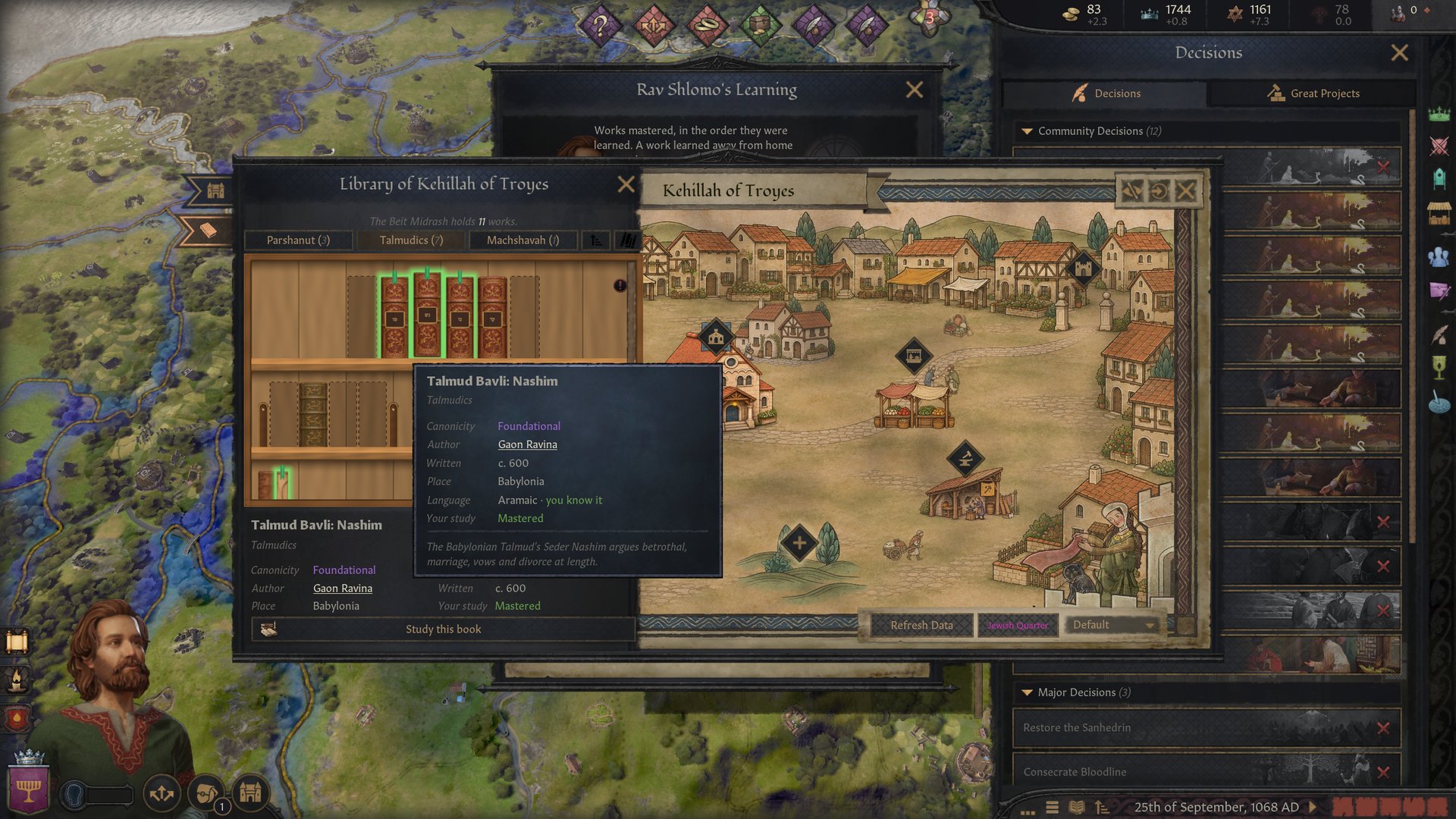
Three different questions
- Ownership: does this community possess a copy?
- Mastery: has this character studied the work successfully?
- Standing: how does the selected rite regard it?
Owning a book does not make every resident its master. A celebrated manuscript artifact is also distinct from a work’s authority in a rite. The library, character learning, and artifact system represent related but different things.
Acquire a work
The Ledger provides routes to obtain eligible works. A nearby library, copying facilities, and distant scholarly networks offer different opportunities. A historical work can be available through those networks after its circulation date even if no registered community currently owns a copy. An unwritten future landmark is a different case.
Copying requires the appropriate scribal facility, not just any Beit Midrash. Greyed-out choices can explain a missing prerequisite. Compare the actual requirement with the Quarter’s buildings and annexes.
Read the rite’s assessment
Sort by rank to see what matters most in the selected tradition. Highest attainable rank explains the current ceiling: the greatest standing the work can reach under that rite’s authority and tenet rules. It is a limit within the game’s reception system, not a universal judgment on the historical book.
Other traditions use a shorter comparison: Rejected, Unknown, Ambivalent, Important, or Holy. A book may be foundational in one rite and controversial in another. Missing Bavli orders should not penalize a community whose rite does not treat them as foundational; harmful books can still have their own consequences.
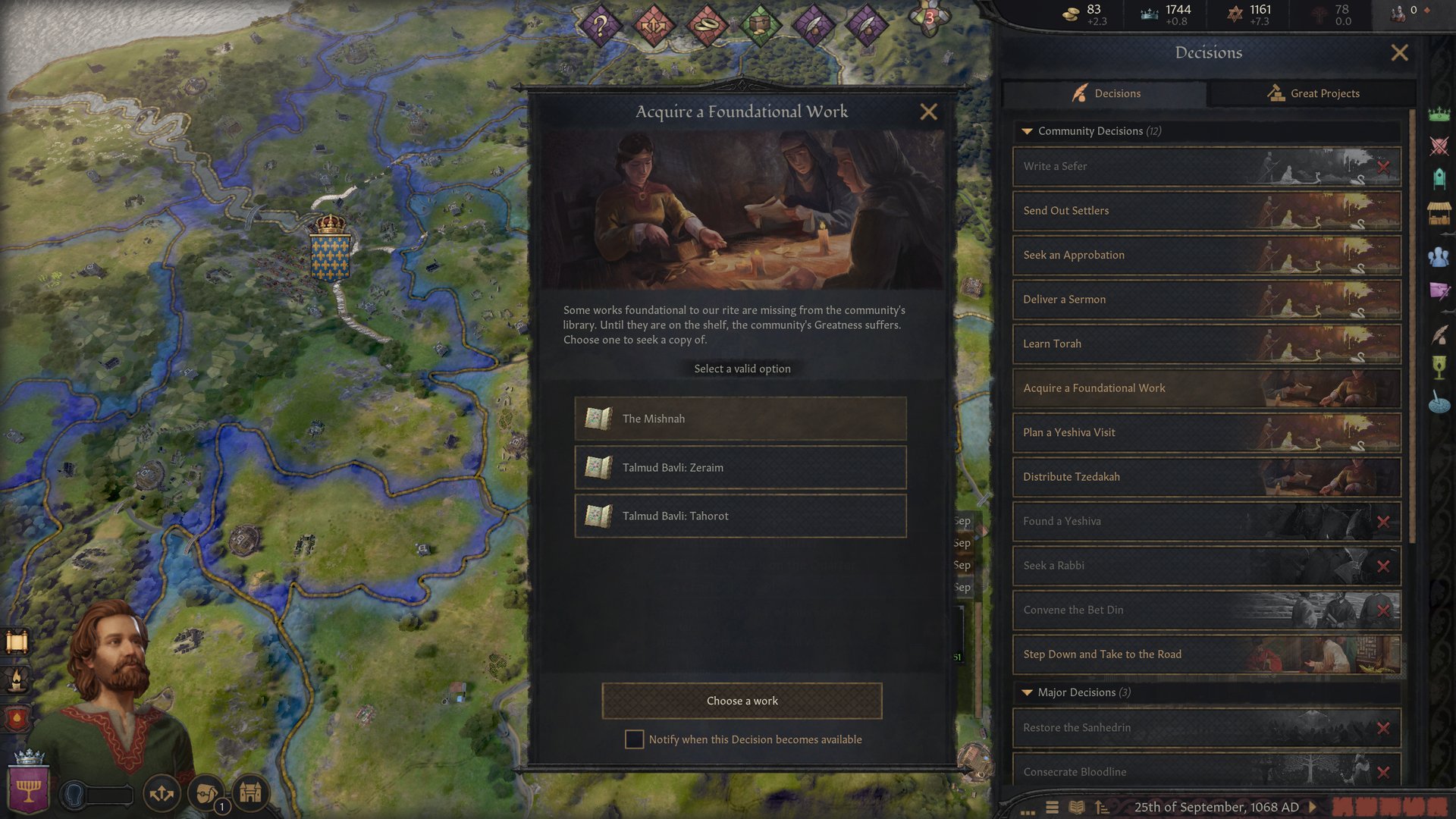
Missing foundational works
Each rite treats some works as foundational. If any are missing from the shelf, a top-bar notice names them, and the community’s Greatness suffers until they are acquired. Click the notice, or take Acquire a Foundational Work, to seek a copy of one.
Wear and repair
Library copies wear out with use and age. Mend a worn copy, or lay one beyond repair in the genizah, as tradition requires for a sacred text.
Movement and survival
A collection belongs to more than its current building. The county-endowment implementation preserves collection and study references when a suitable Jewish temple becomes its seat, with a Quarter fallback if necessary. Crises and expulsion can endanger books; copying and protective institutions matter.
Use the generated catalog for authors, languages, and configured dates. In-game gates remain authoritative for an individual campaign.