Ideas come from study
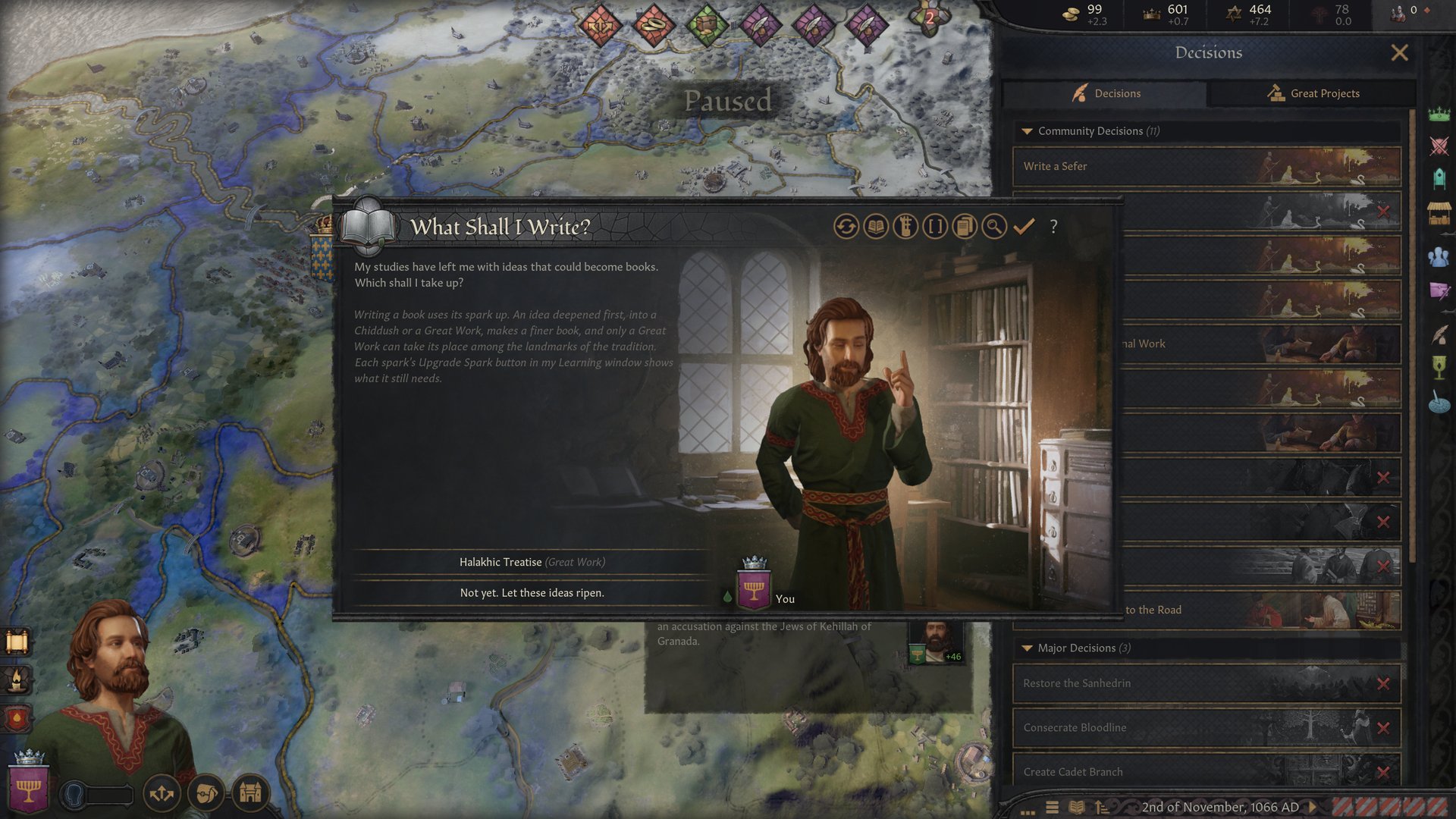
A new campaign begins without writing sparks. First mastery of a sefer can offer an Insight related to that work, with one active slot in each discipline: Parshanut, Talmudics, and Machshavah. A competing idea may ask you to keep the existing one or replace it. Sparks do not fade simply because time passes.
Three tiers
| Tier | Meaning |
|---|---|
| Insight | An initial idea, suitable for a smaller writing project |
| Chiddush | A developed contribution, reached through further study or disciplinary work |
| Great Work | A project ready for an eligible, still-unfilled landmark niche |
An Insight can deepen through aptitude growth, another mastered work, or an action appropriate to its discipline: a sermon, court ruling, responsum, debate, or chavrusa. Requirements count from the spark’s arrival where the system specifies that timing.
Open the Learning window’s Sparks tab. The Upgrade Spark tooltip lists the next rung’s requirements. For the player, meeting them makes an upgrade available; you choose to take it. A project form without a catalogued landmark niche can stop at Chiddush.
Begin the scheme
Use Write a Sefer or the card’s Write button, then select a held idea. Starting consumes that spark. Research, objections, partnership, and revision shape the manuscript’s quality and chance of completion. Language and Learning remain relevant even for a promising idea.
Revising the draft
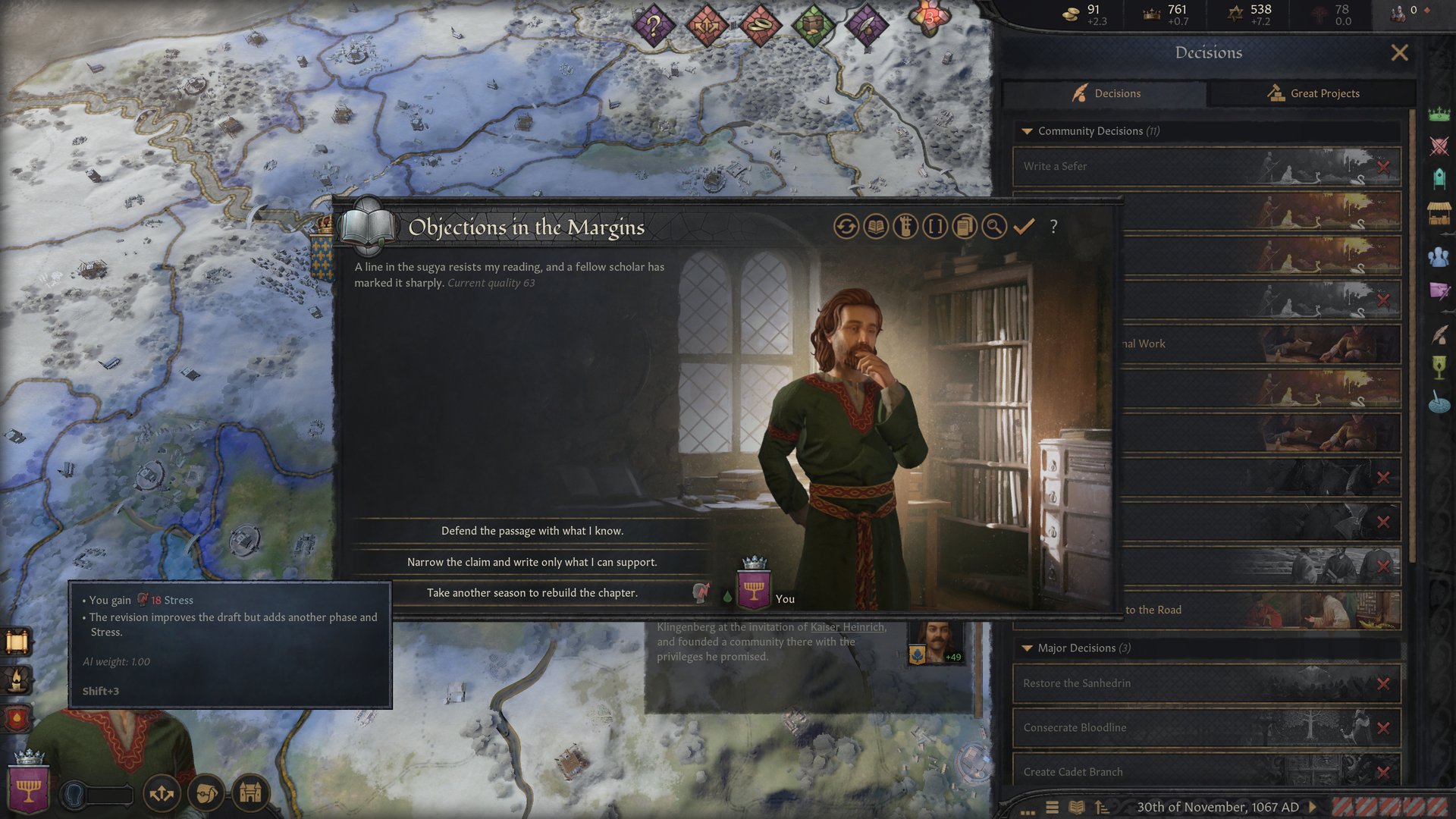
A book takes a year or more to write. Events along the way ask how to gather evidence, for example with your chavrusa, and how to meet a fellow scholar’s objections. You can defend the passage, narrow the claim, or take another season to rebuild at the cost of Stress. Each option’s tooltip gives its effect.
What completion creates
The Manuscript’s Fate reports what the finish did:
- the quality and its tier;
- the spark the book came from;
- its Ledger outcome;
- whether it became a historical landmark, and if not, why not;
- your chavrusa.
The option lists its reward. The manuscript artifact carries the work’s own name.
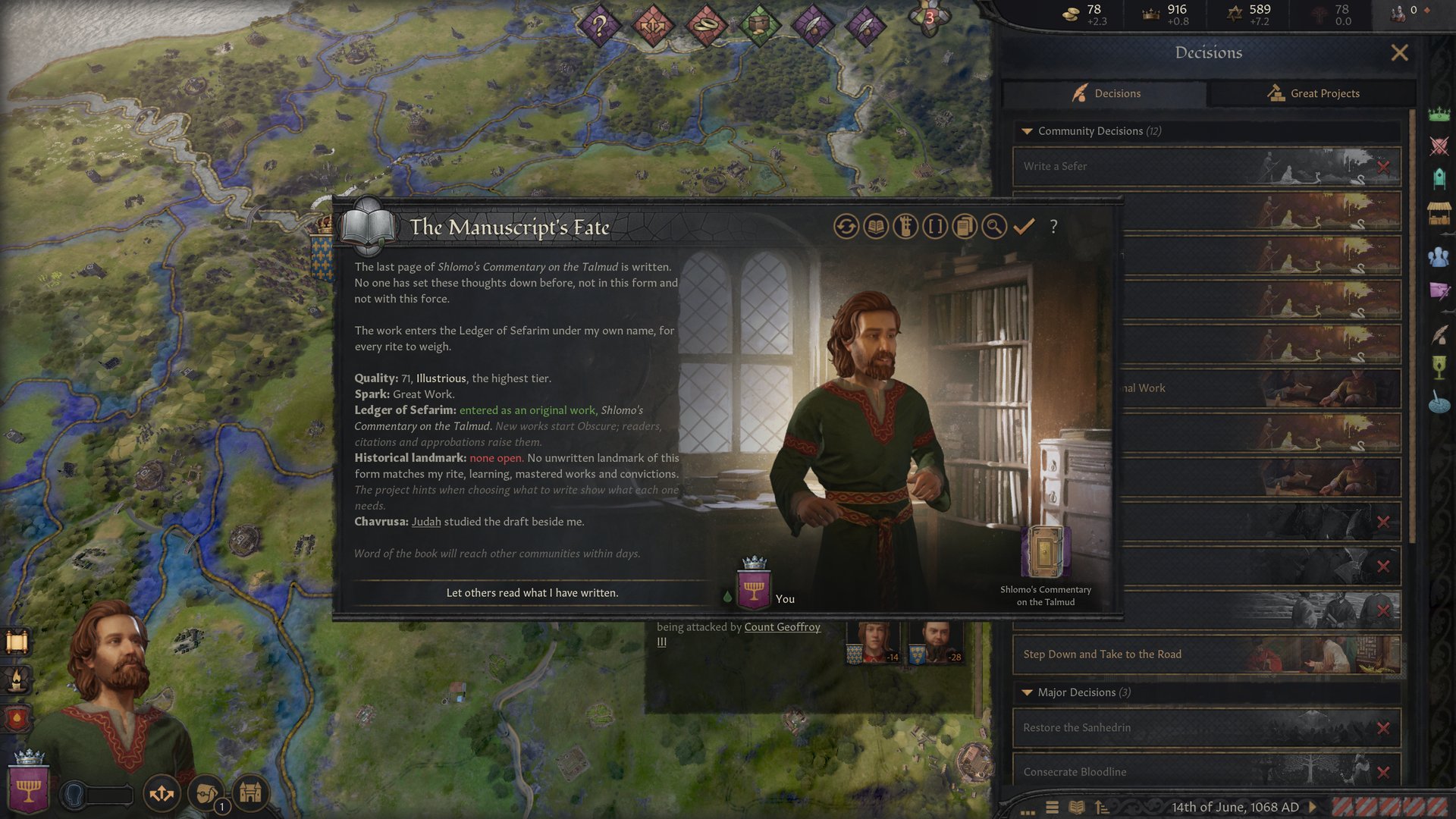
A Great Work that fits an open historical niche, and passes the landmark roll, takes that landmark’s place in history, with you as its author. Otherwise it can enter the Ledger as an original work under its own title. The report says whether a book entered the Ledger, was kept out because the slots were full, or remains a manuscript only.
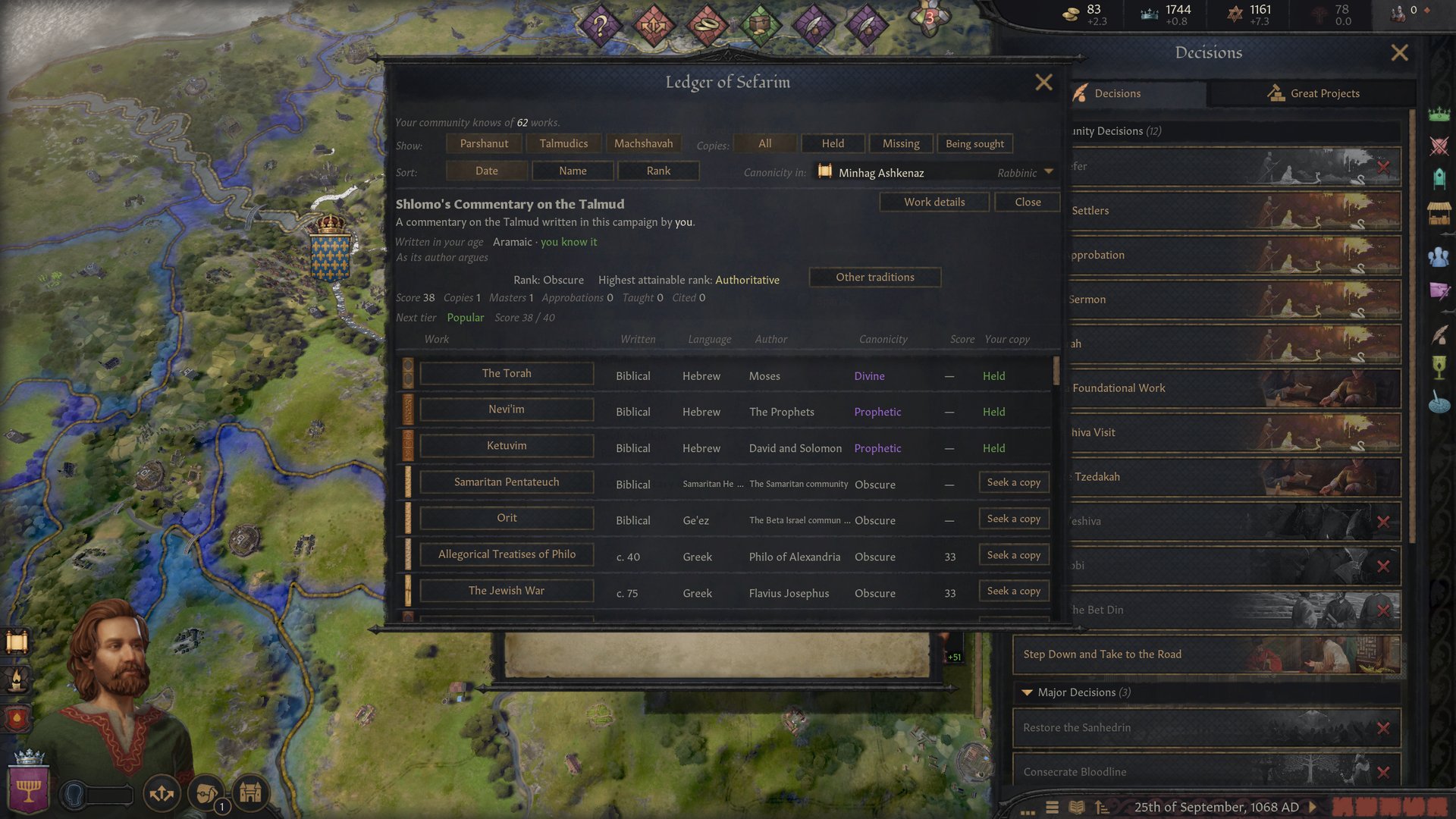
Every new work starts Obscure. Its quality sets how close it starts to Popular. From there, copies, masters, and approbations raise its standing, up to the highest rank its rite allows.
Great Works
About fifty historical books have Great Work paths, each with its own requirements. Some historical authors have shorter routes to their own books. Any qualified scholar may write one, and the book then enters history under that scholar’s name. Readers who hear of a new book may study it, ban it, or travel to meet its author.
Development status
A live run on 26 November 2026 (the Rashi playthrough) confirmed the completion report, the manuscript’s name, and the Obscure starting rank. Rashi’s own Talmud commentary was not open to him in that run: its niche asks for four orders of the Bavli mastered, and he had three. The named historical routes still await a live test. Check the current card and project tooltip rather than an old ambition description.