Income serves institutions
The community’s economy rests on households, the Quarter, trade, and its place in the host realm. Gold pays for construction, books, protection, and relief. Affluence also opens opportunities and creates expectations about what the community can contribute.
Specialise
Economic building choices support different livelihoods. Craft production, a market, a Funduq, and Bankers’ Row serve different combinations of goods, routes, and finance. Recent development connects craft trades and the winery and scribes to their own goods, while the Factor’s House supports route capacity and competitiveness.
Commercial leadership adds an economic emphasis, but does not remove the need for capable officers or favourable conditions. Escorting travellers can support Quarter income and commenda outcomes as well as safety.
Lending
The current lending implementation uses vanilla loans, with community identification and succession handling. Read the debtors panel and the actual loan terms. The faith’s usury doctrine and the borrower’s religious relationship affect which loans and terms are appropriate.
Banking can improve a ruler’s view of the community’s services; unpaid debts can also become a political grievance. The Keep the Pledge Chest task and financial specialisations support lending through their own benefits. Older custom-ledger and quarterly-repayment descriptions are superseded by the vanilla-loan integration.
Give and receive
Tzedakah and mutual aid link communities. A prosperous seat can support a poorer or threatened neighbour; hardship can make receiving help an immediate priority. Giving can bring communal standing, piety, and relationships, while relief helps the recipient recover.
The Gabbai’s charity task strengthens this role and adds religious benefits. Do not assume every gift grants every possible reward: the action, recipient state, and current build determine the result.
Mutual aid between communities
Since 0.2.0, mutual aid lets you ransom captives, send relief, take in refugees, and appeal to others for help. It replaces the old loan ledger. Letters from communities in need arrive with options to send your share, send what they still need, or refuse. Each choice’s tooltip gives its cost in standing and goodwill.
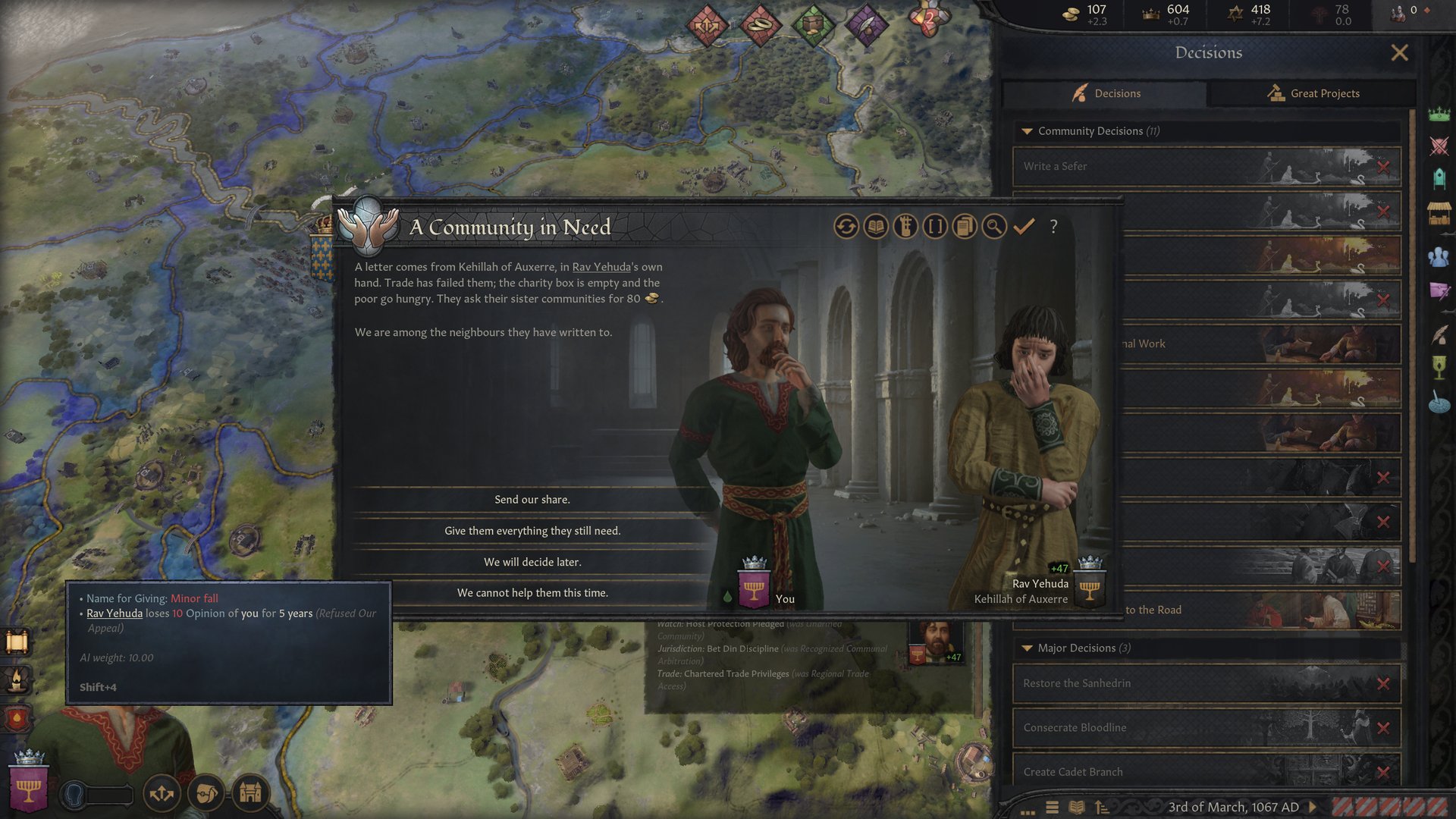
Other 0.2.0 additions: lend to rulers in debt, demand repayment, and enforce bonds; run trade routes and invest in voyages through the Funduq; send the Hospital’s physician to an ill ruler. Jewish merchants and adventurers can belong to a home community and pay it a tithe.
Risk and reserves
A highly profitable arrangement can create political exposure. Revenue farming is the clearest example: it can enrich the community and please the lord while making townspeople angrier. Keep enough liquidity to answer a crisis or repair losses rather than committing everything to the next tier.